|
TRADITIONAL
TIPIS
TENTSMITHS'
roots are in Tipis, this is the structure that started us along this tent-making path. Our Tipis have always
been constructed to meet the highest standards of quality in both
structure and atmosphere and, for twenty years, have met the needs of
people looking for an alternative living space or a historic shelter for
Fur Trade Rendezvous and Pow Wows.
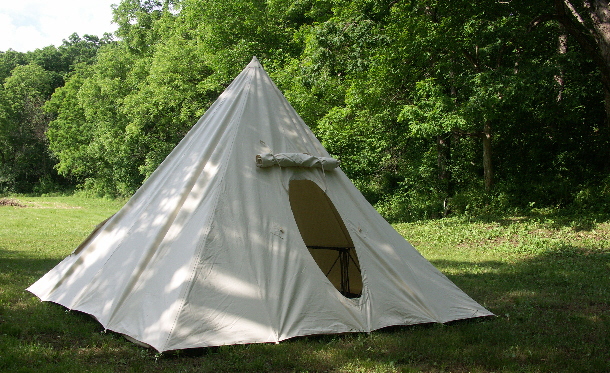
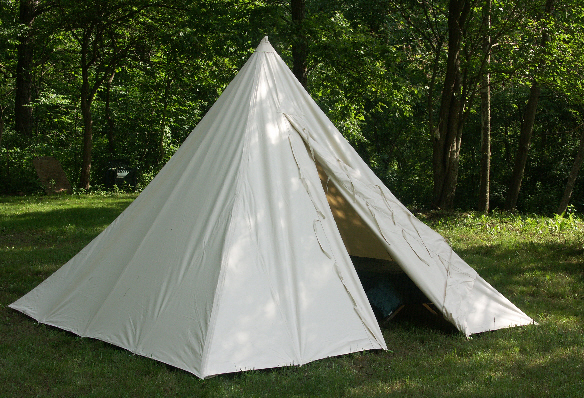
TIPI is a Sioux word for dwelling. The Tipi is the final evolution of the
conical tent, ever popular in the north. It's shape sheds wind and rain
while the smoke flaps allow the owner to adjust for a good smoke draw with
the wind from any direction. Although the Tipi is a bit harder to transport
than the smaller tents, the days and nights spent in this shelter are
impossible to duplicate and become lasting memories.
Tipis were in use long before the Europeans arrived on the scene.
Apparently the earlier Tipis were small (around 12 to 14 feet) to
facilitate travel with only dogs to transport the poles. With the
introduction of the horse, the Indian became better able to supply himself
with the bison hides for Tipi construction and could more easily move
longer poles. Catlin, Bodmer, and Miller all show Tipis from the 12 foot to
18 foot plus range. The larger Tipis, appearing in the photographs of the
reservation period, probably came into being due to the fact that it was no
longer necessary to move them very often. White man use of the Tipi seems
to have been limited to an occasional stay while visiting a tribe for trade
or marrying into an Indian family. Miller paints Indians and Tipis at a
rendezvous and an engraving of the Bonneville Expedition (1845) shows a
Tipi like structure in use beside Pyramid Lake.
The Tipi is made up of two basic components. The cover, stretched over the
outside of the poles, and a liner suspended from the poles, surrounding the
inside. Our covers are a derivative of the Laubin design, the final form
having evolved over the years to be cut correctly and strongly reinforced
in the right places. Our hems are left raw for tying off with the
"stone and string" method, or finished with a hemmed edge and
loops. Liners are now built in one piece so there are no cold spots and the
they can hang tightly to the poles. Our liners are generously cut, tall
enough to act efficiently removing smoke and insulating the interior.
Tipis are not a perfect cone. They lean back to allow the smoke hole to be
directly over the centrally located fire. The base footprint is more that
of a wide egg than a true circle, so the measure is an average of its
diameter. We have found the 16 foot size to be the easiest to transport and
still have room for two or three adults. The 18 footer is extremely roomy
and makes a wonderful camp for an extended Rendezvous.
Tribal styles did exist and did differ. We have, again, based our styles on
the Laubin research and offer Tipis in four basic variations, all based
around the shape of the smoke flaps. (Please see the drawings.) Many more
variations exist for other tribes and we are happy to construct to any
tribal style requested.
When ordering a Tipi, please specify tribal style, size and material. Tipis
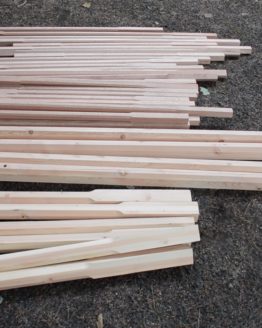
include all canvas components and ropes. Poles, stakes, and lace pins must
be acquired separately.
|
Tipi Diameter
|
Sunforger
|
Sunforger Flame
|
Loops
|
|
9 FOOT, KIDS
|
$250
|
$275
|
$30
|
|
12 FOOT
|
$595
|
$690
|
$30
|
|
14 FOOT
|
$685
|
$800
|
$30
|
|
15 FOOT
|
$760
|
$850
|
$35
|
|
16 FOOT
|
$815
|
$900
|
$35
|
|
18 FOOT
|
$900
|
$1,020
|
$40
|
|
20 FOOT
|
$1,020
|
$1190
|
$45
|
|
22 FOOT
|
$1,130
|
$1330
|
$50
|
|
24 FOOT
|
$1,330
|
$1560
|
$55
|
BOOK
"THE INDIAN TIPI" by Reginald & Gladys Laubin ~ $25
(Included with any tipi order)

Cheyenne -
Sioux -
Crow - Blackfoot
NEED TIPI
POLES?
|